Understanding Fatty Acid Testing: A Clinician’s Guide to the Fatty Acids Profile

Fatty acid balance plays a critical role in inflammation, cardiovascular risk, metabolic function, and brain health. The Fatty Acids Profile™ from Diagnostic Solutions Laboratory provides a comprehensive view of plasma fatty acid status, helping clinicians identify imbalances that may impact multiple body systems.
This guide explains the clinical value of fatty acid testing, how to interpret key sections of the report, and why metrics such as the omega‑6/omega‑3 ratio and Index of Omega‑3 matter for patient care.
What Are Fatty Acids?
Fatty acids are essential components of lipids that support fundamental biological functions.1,2 They:
- Form the structure of cell membranes
- Provide cellular energy
- Regulate inflammatory and metabolic signaling
- Influence hormone and neurotransmitter activity
Fatty acids come from both diet and internal metabolism. Their effects depend on carbon chain length, degree of saturation, and the position of double bonds.3
Because fatty acid composition reflects both dietary intake and metabolic activity, plasma fatty acid testing provides a functional snapshot of nutritional and metabolic status.
Why Order the Fatty Acids Profile?
A plasma fatty acids profile helps clinicians:
- Identify pro-inflammatory vs anti-inflammatory patterns
- Assess cardiovascular and metabolic risk
- Evaluate dietary fat quality and intake
- Detect essential fatty acid deficiencies
- Personalize nutrition and supplementation strategies
Since fatty acids influence multiple systems—including cardiovascular, neurologic, metabolic, and immune function—testing provides actionable insights that go beyond standard lipid panels.
Understanding the Report: Key Sections
Saturated Fatty Acids
Saturated fatty acids contain no double bonds and are typically found in animal products and certain plant oils.3-5 Their health impacts vary depending on the specific fatty acid, total dietary pattern, and metabolic context. Elevated levels may reflect dietary intake or altered fat metabolism.
Monounsaturated Fatty Acids (MUFAs)
MUFAs contain one double bond and are abundant in olive oil, avocados, and nuts.3,4 They are associated with:
- Improved lipid metabolism6
- Better insulin sensitivity
- Cardiovascular support
Changes in MUFA levels may reflect dietary patterns or endogenous fat synthesis.
Polyunsaturated Fatty Acids (PUFAs)
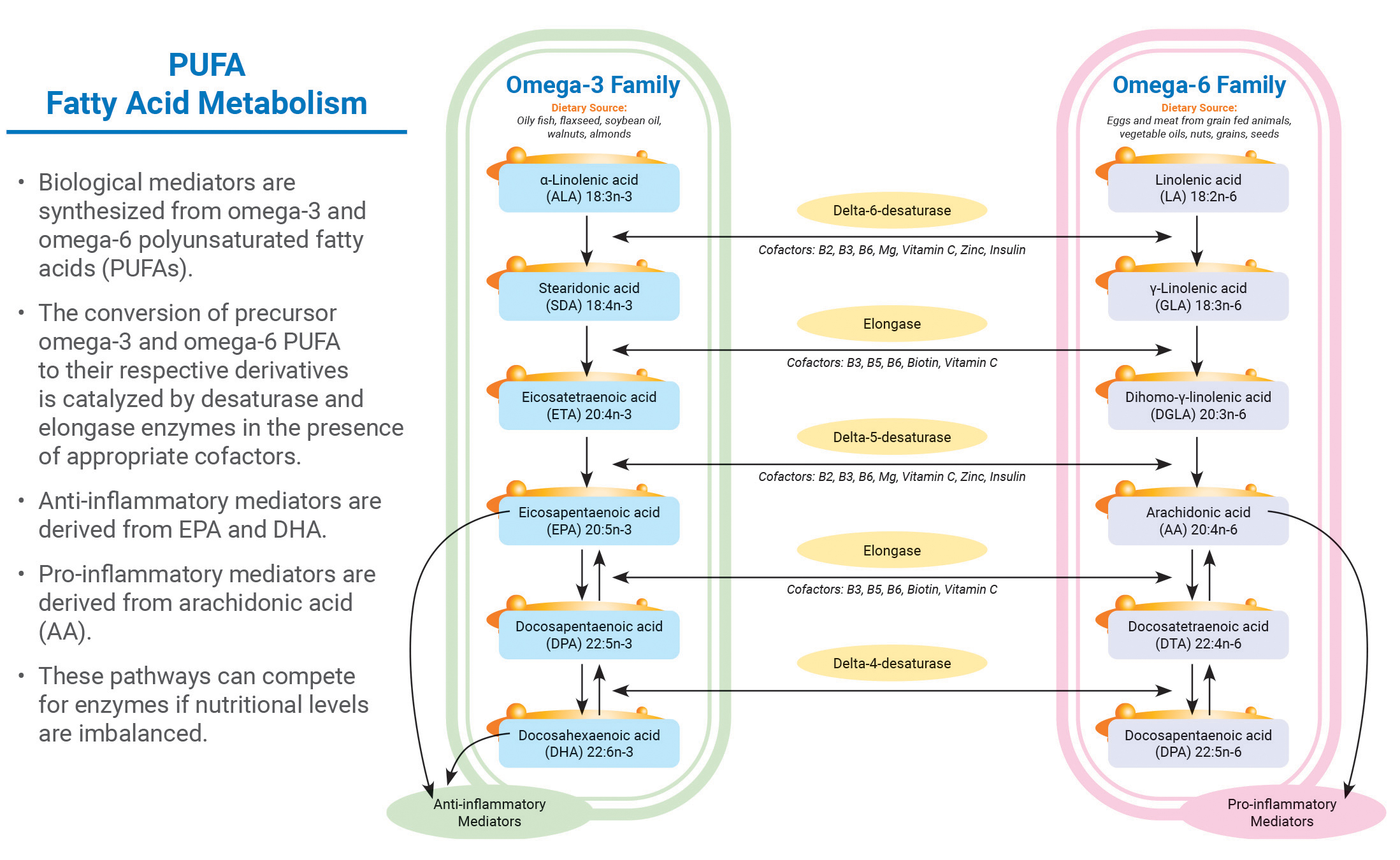
PUFAs contain two or more double bonds and include the essential omega‑3 and omega‑6 fatty acids, which must be obtained through diet. Alpha-linolenic acid (ALA) serves as the entry point for the omega‑3 pathway, while linoleic acid (LA) drives the omega-6 pathway.
Omega-3 fatty acids (including EPA and DHA):
- Support anti-inflammatory signaling7
- Promote cardiovascular and cognitive health8
Omega-6 fatty acids:
- Play important physiologic roles9
- May contribute to inflammatory signaling when excessive relative to omega‑3 intake
This balance is best evaluated using ratio-based markers.
The Omega-6/Omega-3 Ratio: A Key Inflammation Marker
The omega-6/omega-3 ratio is one of the most clinically important indicators on the Fatty Acids Profile.
A higher ratio suggests:
- Greater inflammatory potential
- Increased cardiovascular and metabolic risk
- Low intake or poor status of omega‑3 fatty acids
Modern diets often drive this ratio upward due to high consumption of seed oils and processed foods.9,10 Identifying an elevated ratio helps clinicians guide targeted dietary changes and omega‑3 supplementation.
The Index of Omega-3: Assessing Cardiovascular and Brain Health
The Index of Omega-3 measures the percentage of EPA and DHA relative to total fatty acids.
Clinical significance:
- Higher levels are associated with reduced cardiovascular risk
- Lower levels may indicate increased risk for heart disease, cognitive decline, and inflammatory conditions
- Provides a direct marker to monitor response to omega‑3 therapy
The Index of Omega-3 is especially useful for tracking patient progress over time.
Desaturase Enzyme Activity
Desaturase enzymes convert fatty acids into their active forms. Estimated desaturase activity provides insight into:
- Endogenous fat metabolism
- Insulin resistance and metabolic health11
- Genetic and dietary influences on fatty acid balance12-15
Altered activity patterns may signal underlying metabolic dysfunction even when dietary intake appears adequate.
Next Steps
Clinical Summary and Actionable Insights
The Fatty Acids Profile™ summarizes key imbalances and provides targeted nutritional guidance to help restore healthy fatty acid patterns. Results can be used to:
- Personalize dietary fat recommendations
- Guide omega-3 or other supplementation
- Monitor response to lifestyle interventions
- Support long-term cardiovascular and metabolic risk reduction
Bringing Fatty Acid Testing into Practice
Fatty acid balance is a powerful but often overlooked driver of inflammation and chronic disease risk. The Fatty Acids Profile provides a clear, actionable assessment of plasma fatty acid status, helping clinicians move beyond general dietary advice to precise, individualized care.
Learn more or order the Fatty Acids Profile to bring advanced fatty acid testing into your clinical practice.

Diagnostic Solutions Laboratory
Brought to you by the Diagnostic Solutions Laboratory team. Our commitment is to serve the clinical needs of the health care provider with cutting-edge laboratory medicine by utilizing proven methodologies that are accurate and reliable.
The opinions expressed in this presentation are the author's own. Information is provided for informational purposes only and is not meant to be a substitute for personal advice provided by a doctor or other qualified health care professional. Patients should not use the information contained herein for diagnosing a health or fitness problem or disease. Patients should always consult with a doctor or other health care professional for medical advice or information about diagnosis and treatment.
References
- Cucchi D C-MD, Certo M, Pucino V, Nicolaou A, Mauro C. . Fatty acids - from energy substrates to key regulators of cell survival, proliferation and effector function. Cell Stress. 2019;4(1):9–23. doi:10.15698/cst2020.01.209
- Maulucci G CO, Daniel B, Sansone A, Petropoulou PI, Filou S, Spyridonidis A, Pani G, De Spirito M, Chatgilialoglu C, Ferreri C, Kypreos KE, Sasson S. Fatty acid-related modulations of membrane fluidity in cells: detection and implications. Free Radical Research. 2016;50(1):40–50. doi:10.1080/10715762.2016.1231403
- Kelly RK PZ, Young H, et al. Evaluation of the New Individual Fatty Acid Dataset for UK Biobank: Analysis of Intakes and Sources in 207,997 Participants. Nutrients. Aug 31 2022 2022;14(17)doi:10.3390/nu14173603
- My Food Data. https://www.myfooddata.com
- Liu L TX, Ma P, Li Y. Association of circulation very long chain saturated fatty acids with depression in NHANES 2011-2014. J Affect Disord. Aug 1 2024 2024;358:28–34. doi:10.1016/j.jad.2024.05.008
- Barber TM KS, Pfeiffer AFH, Weickert MO. The Effects of the Mediterranean Diet on Health and Gut Microbiota. Nutrients. Apr 29 2023 2023;15(9)doi:10.3390/nu15092150
- Shramko VS PY, Kashtanova EV, Stakhneva EM, , YI. R. The Short Overview on the Relevance of Fatty Acids for Human Cardiovascular Disorders. Biomolecules. Jul 30 2020 2020;10(8)doi:10.3390/biom10081127
- Skulas-Ray AC WP, Harris WS, et al. Omega-3 Fatty Acids for the Management of Hypertriglyceridemia: A Science Advisory From the American Heart Association. Circulation. Sep 17 2019 2019;140(12):e673–e691. doi:10.1161/CIR.0000000000000709
- AY T. Linoleic acid-good or bad for the brain? NPJ Sci Food. 2020;4(1)doi:10.1038/s41538-019-0061-9
- Blasbalg TL HJ, Ramsden CE, Majchrzak SF, Rawlings RR. Changes in consumption of omega-3 and omega-6 fatty acids in the United States during the 20th century. Am J Clin Nutr. 2011;93(5):950–62. doi:10.3945/ajcn.110.006643
- UN D. A defect in Δ6 and Δ5 desaturases may be a factor in the initiation and progression of insulin resistance, the metabolic syndrome and ischemic heart disease in South Asians. Lipids Health Dis. Published 2010 Nov 9 2010;9(130)doi:10.1186/1476-511X-9-130
- Knez M SJ, Glibetic M, Tako E. The Linoleic Acid: Dihomo-γ-Linolenic Acid Ratio (LA:DGLA)-An Emerging Biomarker of Zn Status. Nutrients. Aug 1 2017 2017;9(8)doi:10.3390/nu9080825
- Arshad Z R-FS, Ebrahimifar M, Mosavi Jarrahi A, Mohammadian M. Association of Delta-6-Desaturase Expression with Aggressiveness of Cancer, Diabetes Mellitus, and Multiple Sclerosis: A Narrative Review. Asian Pac J Cancer Prev. 2019;20(4):1005–1018. doi:10.31557/apjcp.2019.20.4.1005
- Berg J SN, Grant R. Saturated Fatty Acid Intake Is Associated With Increased Inflammation, Conversion of Kynurenine to Tryptophan, and Delta-9 Desaturase Activity in Healthy Humans. Int J Tryptophan Res. 2020;13(1178646920981946)doi:10.1177/1178646920981946
- Banaszak M GI, Drzymała-Czyż S. Fatty Acid Profile and Desaturase Activity in Obesity: Roles, Mechanisms, and Clinical Relevance. Metabolites. 2025;15(9):595.