Fecal Gluten Peptide (stool)
Direct Detection of Recent Gluten Ingestion for Accurate Dietary and Lifestyle Management
Available as a GI-MAP Add-On Panel or Standalone Test
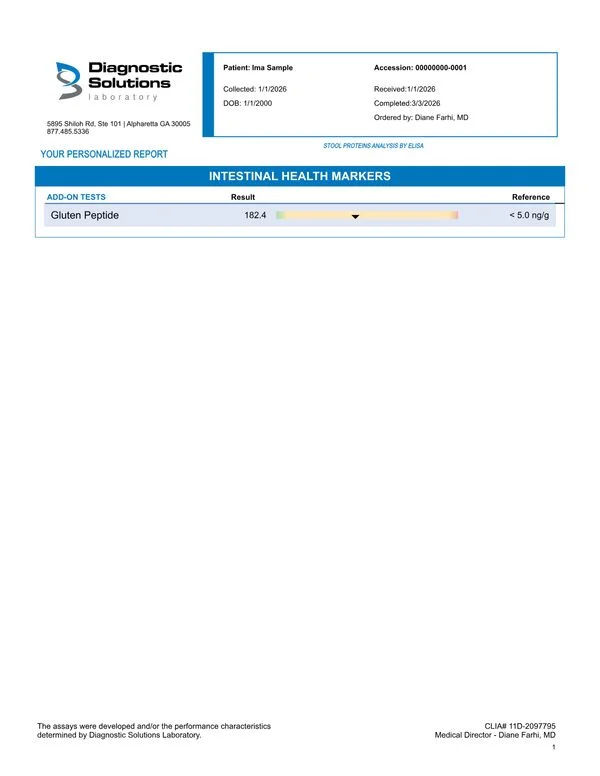
The Fecal Gluten Peptide Test is a gluten exposure test that provides a direct, quantitative measurement of gluten ingestion by detecting the 33‑mer gliadin peptide in stool. Unlike traditional gluten sensitivity or gluten intolerance tests, which rely on symptoms or immune response, this stool gluten test directly detects gluten in stool and confirms recent ingestion within the past two to four days.

Clinical Information
Understanding Gluten Exposure in Celiac Disease and Gluten Sensitivity
Gluten-containing grains — such as wheat, rye, barley, and oat — are broken down into gliadin and glutenin during digestion. A specific fragment, known as the 33-mer gliadin peptide, is resistant to degradation and remains intact in the gastrointestinal tract.
In patients with celiac disease (CD), this peptide drives immune activation and intestinal damage. In non-celiac gluten sensitivity (NCGS), it may contribute to GI inflammation, food sensitivities, and intestinal permeability.
When intestinal permeability is present, gluten exposure may lead to extra-intestinal symptoms, including:
- Skin conditions
- Headaches
- Fatigue
- Behavioral or neurological symptoms
This stool gluten test directly detects the presence of gluten peptide, providing objective evidence of recent gluten intake.

Why Evaluate Gluten Exposure?
Maintaining a strict gluten-free diet is essential for patients with celiac disease and is commonly recommended for those with gluten sensitivity. However, adherence is difficult due to:
- Hidden gluten in foods and medications
- Cross-contamination in “gluten-free” products
- Inconsistent labeling
- Lack of symptom correlation
Many patients relying on symptoms or traditional gluten intolerance tests may still be unknowingly exposed.
The Fecal Gluten Peptide Test offers new possibilities for managing patients with celiac disease or gluten sensitivity by identifying recent (2–4 day) gluten exposure. This enables practitioners to investigate inadvertent sources of gluten—from diet, cross-contamination, or other products — and refine dietary strategies to improve adherence and clinical outcomes, particularly in patients who continue to experience symptoms.
This gluten exposure test provides a noninvasive and objective way to:
- Confirm recent gluten ingestion
- Monitor gluten-free diet compliance
- Identify hidden or accidental exposures

Clinical Utility of the Gluten Exposure Test
The Fecal Gluten Peptide Test supports clinical decision-making by:
- Providing quantitative measurement of gluten exposure
- Monitoring adherence to a gluten-free diet
- Detecting unintentional gluten ingestion, even without symptoms
- Supporting evaluation of persistent symptoms in gluten-free patients
- Assisting in assessment of refractory celiac disease
Because this is a direct measurement of gluten peptide, results are not impacted by immune suppression and avoid the ambiguity of antibody-based testing as an assessment of gluten exposure.
Patient Cohort
Who Should This Test Be Ordered For?
Consider this test for patients who:- Have celiac disease and require strict dietary adherence
- Have diagnosed or suspected non-celiac gluten sensitivity
- Continue to experience symptoms despite a gluten-free diet
- Are striving to achieve a GF diet, but need confirmation of recent gluten exposure
- Are attempting to identify hidden sources of gluten
- Require objective monitoring beyond symptom-based assessment

Conditions Associated with Gluten Exposure and Sensitivity
This test may be clinically useful in patients with:
- Celiac disease
- Non-celiac gluten sensitivity
- Irritable bowel syndrome (IBS)
- Chronic bloating or digestive discomfort
- Intestinal permeability (“leaky gut”)
- Autoimmune-related conditions
- Skin disorders associated with gluten exposure
- Neurological or behavioral symptoms with dietary triggers
Gluten Exposure Test vs. Gluten Sensitivity or Intolerance Testing
Traditional gluten sensitivity or gluten intolerance tests often rely on antibody response or symptom tracking to monitor gluten exposure. In contrast, the Fecal Gluten Peptide Test:
- Directly measures gluten peptide in stool
- Confirms actual ingestion, not immune response
- Is not affected by immune status
- Eliminates uncertainty from cross-reactivity
If gluten peptide is detected, gluten has been consumed—providing clear, actionable data for both practitioner and patient.

Consider Ordering Alongside GI‑MAP®
The Fecal Gluten Peptide Test can be ordered as a standalone gluten exposure test or added to the GI-MAP for a more comprehensive evaluation.
While this stool gluten test confirms recent gluten ingestion, the GI-MAP provides deeper insight into:
- Gut microbiome balance
- Pathogens and opportunistic organisms
- Inflammation markers
- Digestive function
Together, these tests help connect gluten exposure with underlying gut dysfunction, supporting more targeted and effective clinical strategies.

Test Ordering Information
The Fecal Gluten Peptide Test is available:
- As a standalone gluten exposure test
- As an add-on to GI-MAP
If you already have an account with us, you may order through our online Practitioner Portal accessible at the top of this page.
Additional Resources:
- Gluten Exposure blog - Learn how to use Fecal Gluten Peptide in practice
- IgG Food Explorer™ – Food sensitivity test that can assess gluten sensitivity
- Video – Explanation of the Fecal Gluten Peptide Test